

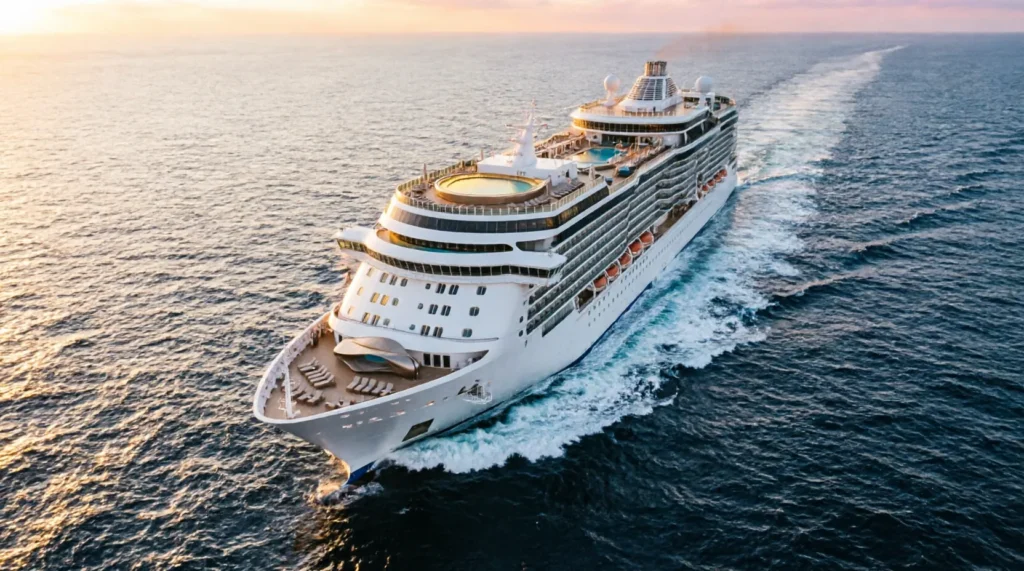
Quick answer: Choose aft cabins if you prefer larger balconies, stunning wake views, and less motion sensitivity; choose forward cabins if you want quicker port access, lower prices, and don’t mind more noticeable ship movement.
Cruise travelers constantly debate whether forward or aft cabins provide the better experience. The confusion stems from conflicting advice about motion, views, noise, and value—making it difficult to decide before booking. Understanding the real differences helps you select the perfect stateroom for your cruising style.
Quick Comparison: Forward vs Aft Cabins
| Term | Meaning / When to use | Example sentence |
|---|---|---|
| Forward | Cabins located at the front of the ship; best for budget-conscious travelers who prioritize quick disembarkation and don’t experience severe seasickness | “We booked a forward cabin on Deck 8 to save $400 and enjoyed being first off the ship at every port.” |
| Aft | Cabins positioned at the rear of the ship; ideal for travelers seeking larger balconies, spectacular wake views, and smoother sailing in rough seas | “Our aft stateroom featured a 200-square-foot balcony where we watched the ship’s wake stretch endlessly behind us.” |
When to Use Forward Cabins
Forward cabins occupy the front section of the vessel, closest to the bow. the forward section refers to the direction toward the bow or front of a ship. Choose forward locations when:
- Budget matters most: Forward cabins typically cost 15-25% less than equivalent aft staterooms, making them excellent value for money-conscious cruisers
- You prioritize quick port access: Being at the front means you’re among the first passengers to disembark during tender operations and port days
- You spend minimal time in your room: If your strategy involves exploring public decks, dining venues, and ports rather than lounging in your cabin, the forward location’s drawbacks become irrelevant
- You’re a light sleeper who doesn’t experience motion: While forward cabins experience more movement, some travelers actually prefer the gentle rocking sensation
Real-world example from a recent cruise booking: “I booked forward cabin 7234 on a 7-day Caribbean cruise and saved $380 compared to the aft option. Since we were up by 7 AM daily exploring ports, the extra motion didn’t bother us, and we loved being steps away from the forward lounge.”
Email scenario: “Hi Sarah, thanks for asking about our cabin! We’re in 6142 forward on Deck 6. Yes, we feel the ship move more here, especially on rough seas, but the price difference was worth it for our family of four. We’re barely in the room anyway.”
When to Use Aft Cabins
Aft cabins sit at the stern or rear of the ship. These positions offer distinct advantages that justify their premium pricing for many cruisers. Select aft locations when:
- You crave spectacular views: Aft balconies provide uninterrupted views of the ship’s wake churning through turquoise waters—a mesmerizing sight you can’t get anywhere else onboard
- Larger outdoor space matters: Aft balconies are often 30-50% larger than standard side or forward balconies, sometimes featuring wraparound designs
- You experience motion sensitivity: Counterintuitively, many seasickness sufferers report feeling better in aft cabins because the motion feels more predictable and less jarring than forward movement
- You enjoy sunset viewing: Westward itineraries offer breathtaking sunsets from aft-facing balconies without fighting crowds on upper decks
- Privacy is important: Aft balconies typically offer more seclusion since they’re not overlooked by neighboring cabins
Resume/Cruise review example: “Selected aft cabin 9876 on Royal Caribbean’s Symphony of the Seas specifically for the oversized balcony (210 sq ft vs standard 80 sq ft). The wake views during sea days became the highlight of our anniversary trip.”
Text message scenario: “OMG our aft balcony is HUGE! It’s like having a private terrace. We can actually fit two lounge chairs and a table with room to walk around. The wake view is hypnotic—worth every extra penny!”
aft cabins command premium pricing because they deliver tangible benefits that enhance the overall cruise experience, particularly for travelers who view their stateroom as a destination rather than just a place to sleep.
How to Remember the Difference
Use this simple memory trick: Aft = Amazing views, Forward = First off.
The word “aft” contains the letter “A,” which can remind you of “Amazing balcony” or “Awesome wake views.” Meanwhile, “forward” starts with “F,” representing “First to disembark” or “Frugal choice” (since they cost less).
Another editor’s trick I’ve developed after reviewing hundreds of cruise cabin guides: Think of the ship like a car. The forward section is like sitting in the front passenger seat—you feel every bump and turn more intensely, but you see where you’re going first. The aft is like the back seat—smoother ride, better for watching the scenery pass behind you, and often more comfortable for relaxation.
Here’s a professional insight most first-time cruisers miss: The “mid-ship equals smoothest ride” advice is partially true, but the difference between mid-ship and aft is negligible on modern ships with stabilizers. However, the difference between forward and mid/aft is significant. If you’re choosing between forward and aft specifically for motion concerns, aft almost always wins.
Common Mistakes and Exceptions
Mistake #1: Assuming all forward cabins are noisy While some forward cabins near the bow thrusters or anchor mechanisms can experience noise, modern ships have excellent soundproofing. Forward cabins on mid-to-upper decks (7-12) typically avoid mechanical noise entirely. The real issue isn’t noise—it’s motion.
Mistake #2: Believing aft cabins are always worth the premium Not all aft cabins are equal. Aft cabins on lower decks (2-4) may have obstructed views due to lifeboats or ship structure. Always check deck plans carefully. Additionally, if your itinerary features mostly port days with early mornings, you might never enjoy that expensive aft balcony.
Mistake #3: Ignoring itinerary and season Forward cabins on Alaska cruises during calm Inside Passage sailing? Perfectly fine. Forward cabins on a transatlantic crossing in November? Potentially miserable. Always consider your specific route and weather patterns. Caribbean and Mediterranean sailings in summer typically feature calm seas where forward motion is minimal.
Exception: Ultra-modern ships with advanced stabilizers Newer vessels like Royal Caribbean’s Icon class or Norwegian’s Prima class feature cutting-edge stabilization technology that significantly reduces the forward/aft motion difference. On these ships, the decision becomes more about views and budget than seasickness concerns.
US vs UK spelling note: While Americans spell it “forward” and the British also use “forward” (not a spelling difference like “gray/grey”), the nautical term “aft” remains consistent across all English variants. Don’t confuse this with “after,” which is different—though “aft” does derive from Old English “æftan” meaning “behind.”
Real booking mistake I’ve seen repeatedly: A client booked forward cabin 1234 on a small expedition ship for an Antarctica voyage, assuming the savings would be smart. By day two of Drake Passage crossing, they were miserable and requested a cabin change (which wasn’t available). That $300 savings cost them three days of their $8,000 trip. Always match cabin location to itinerary intensity.
Frequently Asked Questions
Do forward or aft cabins have more motion? Forward cabins experience more pronounced up-and-down pitching motion, especially in rough seas, while aft cabins feel more of a side-to-side rolling sensation that many find less disruptive to balance and comfort.
Are aft balconies really bigger than forward balconies? Yes, aft balconies are typically 2-3 times larger than standard forward or side balconies, often ranging from 150-300 square feet compared to the standard 40-80 square feet found in forward locations.
Which is better for avoiding seasickness: forward or aft? Aft cabins are generally better for seasickness sufferers because the motion feels more stable and predictable, though mid-ship cabins on lower decks remain the gold standard for those with severe motion sensitivity.
Do forward cabins get more wind on balconies? Forward-facing balconies (rare on most ships) would experience extreme wind, but most forward cabins are side-facing with standard wind exposure; however, the forward location itself doesn’t create windier balcony conditions compared to aft.
Is the price difference between forward and aft worth it? For travelers who spend significant time on their balcony or prioritize smooth sailing, the 15-30% premium for aft cabins delivers tangible value; for port-intensive itineraries where you’re off the ship by 8 AM daily, forward cabins offer better overall value.

Tyler Miller is an enthusiastic language analyst with a focus on word comparisons who has spent the past five years contributing to WhichWordHub with insightful content. Graduating with a degree in English Language and Linguistics from the University of Michigan, Tyler quickly developed a keen interest in how subtle differences in word choice can alter meaning and tone. Prior to his current role, he worked as a freelance writer and language tutor, where he gained valuable insights into the varied challenges learners face with English vocabulary. His passion for helping others understand these subtleties inspired him to write extensively on word distinctions and their practical applications. Tyler’s articles often emphasize context-driven language use and the importance of selecting the right word to convey the intended message accurately. He is committed to guiding readers through the complex web of English vocabulary, offering clear explanations and real-world examples to enhance their linguistic proficiency.