

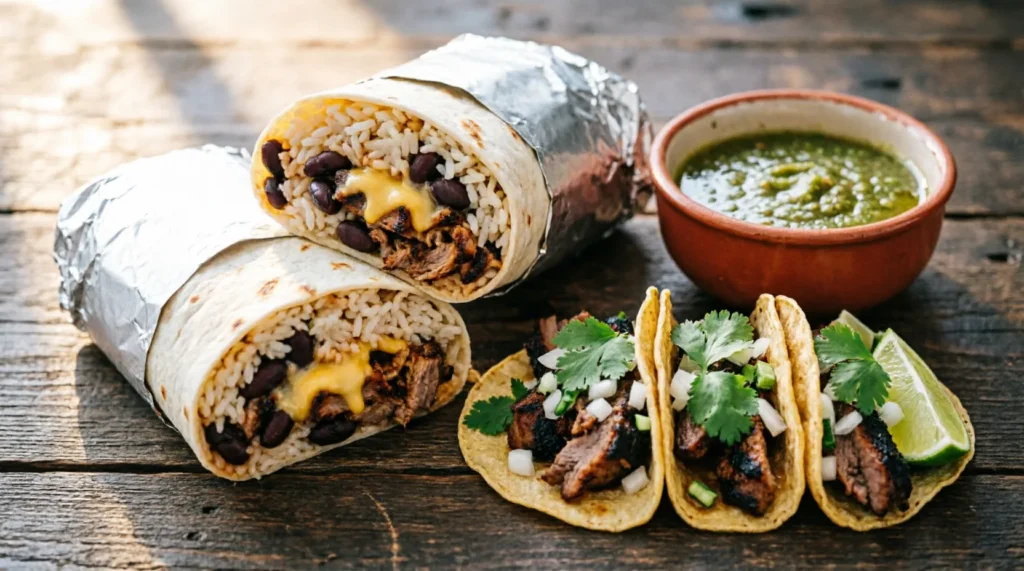
Quick answer: A taco is a small tortilla folded around its filling and left open on top, while a burrito is a large flour tortilla rolled into a fully sealed cylinder. If you can see the filling, you are holding a taco; if it is wrapped like a parcel — usually in foil — you are holding a burrito.
Both dishes pair a tortilla with a filling, and American fast-food menus have blurred the line so thoroughly that plenty of writers use the words interchangeably. Add the fact that breakfast tacos and breakfast burritos share nearly identical ingredients, and even careful food bloggers slip. As a copy editor who has red-penciled more restaurant menus and catering emails than I can count, I can tell you the distinction is rock-solid once you know what to look for.
| Term | Meaning / When to use | Example sentence |
|---|---|---|
| Burrito | A large (10–12-inch) flour tortilla rolled and sealed into a closed cylinder around a hefty filling such as rice, beans, meat, and cheese. Use “burrito” when the tortilla fully encloses the food and it is eaten out of hand, often unwrapped from foil. | “She cut the burrito in half and steam rose from the rice and black beans inside.” |
| Taco | A small (5–6-inch) corn or flour tortilla folded — not rolled — around a filling, left open on top and usually eaten from a plate. Use “taco” when the filling is visible and the tortilla works as an open fold, soft or crispy. | “He topped each taco with chopped onion, cilantro, and a squeeze of lime.” |
One grammar aside before we go deeper: because this comparison involves exactly two items, the correct preposition is “between,” never “among.” According to the Wikipedia entry on Between, “between” marks a one-to-one relationship between distinct items, which is precisely what a burrito-versus-taco face-off is.
When to use burrito
The rule in plain English: call it a burrito when a large flour tortilla is rolled tight and sealed shut around the filling, so the food is completely enclosed.
Structure beats ingredients every time. A burrito is built like a package: the filling goes in the center, the sides fold in, and the tortilla rolls into a closed cylinder that rests seam-side down. Rice and beans are classic burrito cargo because the sealed wrap carries loose, heavy fillings without spilling.
Size is your secondary clue. Burrito tortillas run 10 to 12 inches across — about the size of a dinner plate — and the finished product is a one-handed meal that frequently needs foil to hold its shape.
Examples in the wild:
- “I ordered a chicken burrito the size of a paperback novel.”
- “The breakfast burrito was stuffed with scrambled eggs, potatoes, and chorizo.”
- “Wrap each burrito tightly in foil so it survives the drive home.”
The three-part burrito test
When a manuscript or menu lands on my desk, I run three quick checks before letting the word “burrito” stand:
- A flour tortilla, 10 inches or larger.
- Rolled and sealed — no open top, no visible filling until you cut or bite.
- A heavy filling that would spill from an open fold: rice, beans, cheese, meat, sometimes the whole refrigerator.
A real error I fixed
A catering company once sent me this line in a promotional email:
- Wrong: “Try our new beef tacos — rolled shut in 12-inch flour tortillas with rice, beans, and cheese, wrapped in foil.”
- Right: “Try our new beef burritos — rolled shut in 12-inch flour tortillas with rice, beans, and cheese, wrapped in foil.”
Everything after the dash describes a burrito. The moment the tortilla seals around rice and beans, “taco” is the wrong word, no matter what the kitchen calls it.
When to use taco
The rule in plain English: call it a taco when a small tortilla is folded around the filling and left open on top, so you can see and garnish what is inside.
A taco is a fold, not a package. The tortilla — traditionally a 5- to 6-inch corn tortilla in Mexico, or a crispy fried shell in much of the United States — cradles the filling in a U-shape and stays open along the top. That open architecture is why tacos are finished at the table with salsa, onion, cilantro, and lime: the toppings have somewhere to land.
Tacos are also plate food. Because the fold spills if you tip it, tacos travel on a plate or in a rack, not in foil, and you eat them in a few bites each — usually several per person.
Examples in the wild:
- “The street vendor handed me three tacos al pastor on warm corn tortillas.”
- “Crispy tacos shatter at the first bite, so keep napkins close.”
- “Add the salsa verde right before serving so the tacos do not turn soggy.”
A real error I fixed
A reader once texted me a photo of his order with this message:
- Wrong: “They messed up my order — I asked for crispy burritos with lettuce and cheese.”
- Right: “They messed up my order — I asked for crispy tacos with lettuce and cheese.”
A hard, U-shaped shell that stays open on top is a taco by definition. “Crispy burrito” is a contradiction in terms: the moment you deep-fry a sealed roll, you have wandered into taquito territory, and that is a different word entirely.
And here is one from a line cook’s résumé that crossed my desk:
- Wrong: “Folded 200+ burritos per shift around grilled chicken, salsa, and crema.”
- Right: “Folded 200+ tacos per shift around grilled chicken, salsa, and crema.”
Small tortilla, open fold, garnish on top: those are tacos, and saying so makes the résumé line accurate and vivid.
How to remember the difference
My favorite mnemonic is two words long: tacos are folders; burritos are bundles.
- Taco starts with T, like “top open” — you can see the filling from above.
- Burrito starts with B, like “bundle” — the filling is wrapped up and hidden.
According to Wikipedia’s article on Difference, a difference is simply the quality that makes one thing distinguishable from another — and for these two dishes, the distinguishing quality is geometry, not ingredients. Eggs and chorizo can appear in both; the wrap decides the name.
That is the editor-level insight I want you to keep: when in doubt, ignore the filling and look at the seam. Open fold with visible filling equals taco. Rolled, sealed cylinder equals burrito. Apply that one check and you will never mislabel either dish again.
Common mistakes and exceptions
Even with a solid rule, a few edge cases trip up experienced writers. Here are the ones I correct most often.
Breakfast tacos vs. breakfast burritos
These two share a filling — eggs, cheese, potatoes, chorizo — and often a flour tortilla, so writers swap the names constantly. Keep the structural rule: a breakfast taco is a small flour tortilla folded open around the eggs, while a breakfast burrito is a large tortilla rolled and sealed, usually foiled for the commute. Texas will defend the breakfast taco with its life, and correctly so.
Burrito bowls
A “burrito bowl” holds burrito fillings — rice, beans, meat, salsa — with no tortilla at all. It is neither a burrito, because nothing is wrapped, nor a taco, because nothing is folded. Use the compound name “burrito bowl” and never shorten it to either word alone.
Taquitos, flautas, and rolled tacos
Small tortillas rolled tight and fried look like miniature burritos, but they are taquitos or flautas. They differ from a burrito in size and fried finish, and from a taco in the sealed roll. When a menu calls them “rolled tacos,” that is a regional Texas term for a specific dish — do not generalize it.
Hard shells and regional defaults
In much of the United States and almost everywhere in the UK, “taco” defaults to the preformed crispy shell you buy in a supermarket box. In Mexico, a taco is a soft corn tortilla, and the crispy U-shell is a Tex-Mex import. Both are still tacos, because both stay open on top — the shell’s texture never changes the word.
Burritos, meanwhile, are a northern Mexican specialty — think Sonora and Chihuahua — that crossed the border and grew up in California’s Mission district. In central and southern Mexico the word is rare, so a travel piece set in Oaxaca should lean on “taco” and treat “burrito” as the local outlier it is.
US vs. UK usage
British “burrito bars” build sealed wraps to order, which matches my rule perfectly, but UK food pages sometimes label any folded tortilla dish a burrito. If you write for a British audience, keep the sealed-wrap test anyway: it matches how UK menus actually use “burrito” for the wrapped item and “taco” for the crispy shell.
Frequently Asked Questions
Is a burrito just a big taco? No. Size is a useful clue, but the real distinction is structure: a taco is folded and open on top, while a burrito is rolled and sealed in a large flour tortilla.
Are burritos authentic Mexican food? Yes, regionally. Burritos are a genuine northern Mexican dish, while tacos are eaten across the entire country.
Can a taco be made with a flour tortilla? Absolutely. Northern Mexico and Texas breakfast tacos use small flour tortillas; the open fold, not the grain, is what makes it a taco.
Which is healthier, a taco or a burrito? Tacos usually come in lower in calories simply because they carry less tortilla, rice, and cheese, though the fillings matter more than the name.

Susan Robinson is a seasoned language expert with over 15 years of experience specializing in English word comparisons. With a Ph.D. in English Literature from Oxford University, Susan possesses an in-depth understanding of language nuances and usage. Her academic journey revealed the profound impact of word choice on effective communication, fueling her passion for this niche field. Prior to joining WhichWordHub, Susan taught advanced ESL courses, where she developed innovative methods to clarify word distinctions for non-native speakers. At WhichWordHub, she is dedicated to crafting comprehensive guides that deconstruct complex language concepts into easily digestible information. Her articles often delve into common language pitfalls and provide practical advice on vocabulary enhancement. Susan’s goal is to foster a deeper appreciation for word precision and aid readers in mastering the art of eloquent expression.