

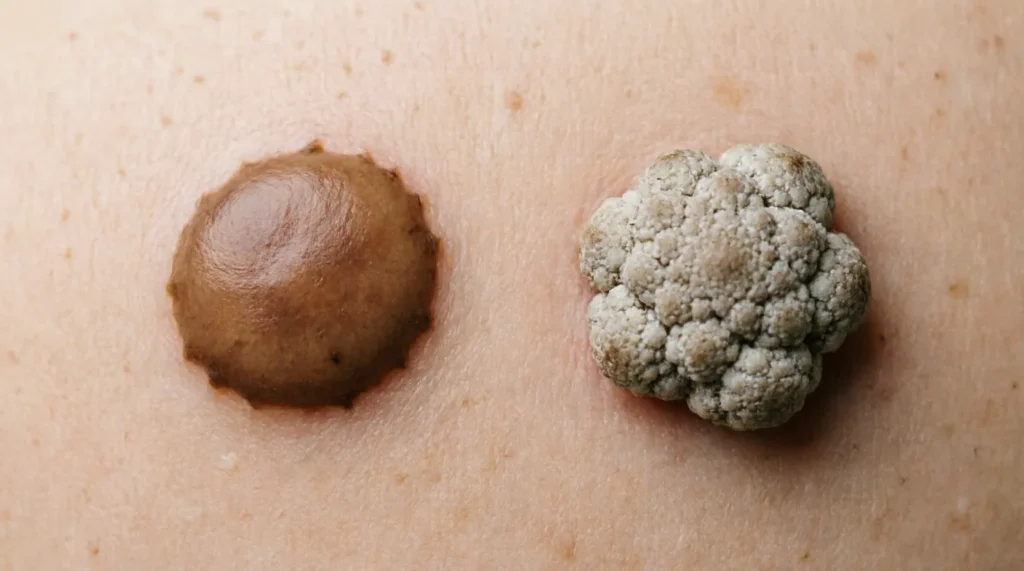
Quick answer: A mole is a cluster of pigmented skin cells (melanocytes) that is typically flat or slightly raised, symmetrical, and uniform in color, while a wart is a rough, bumpy growth caused by the human papillomavirus (HPV) that often has a cauliflower-like texture and may contain tiny black dots. Moles are generally genetic or sun-related and can carry cancer risk if they change, whereas warts are contagious viral infections that are benign but spread through contact.
People frequently confuse these two common skin growths because both appear as small, localized bumps on the skin’s surface, leading to unnecessary anxiety or delayed medical care. As a copy editor who reviews health content and personal essays daily, I see this terminology mix-up constantly in patient forum posts, beauty blogs, and even some wellness newsletters where writers use “mole” and “wart” interchangeably. This linguistic imprecision is not just a grammatical annoyance; it reflects a fundamental misunderstanding of dermatology that can have real consequences for self-diagnosis and treatment choices. Understanding the precise difference between mole and wart is essential for accurate communication with healthcare providers and for recognizing when a skin lesion requires professional evaluation versus over-the-counter management.
| Term | Meaning / When to Use | Example Sentence |
|---|---|---|
| Mole | A benign proliferation of melanocytes (pigment-producing cells); usually symmetrical, uniformly colored, and stable over time; monitor for ABCDE changes. | “The dermatologist confirmed the dark spot on my shoulder was a harmless mole, but advised me to watch for any asymmetry or border irregularity.” |
| Wart | A hyperkeratotic papule caused by HPV infection; typically rough, grainy, or cauliflower-textured, sometimes with thrombosed capillaries (black dots); contagious via direct contact. | “After noticing a rough bump on my finger with tiny black specks, I realized it was a wart and started salicylic acid treatment to prevent spreading it to my other hand.” |
When to Use Mole
Use the term mole when describing a circumscribed, pigmented lesion composed of nevus cells that arises from genetic predisposition or ultraviolet exposure rather than infection. In clinical and lay contexts alike, “mole” specifically denotes a melanocytic nevus, which is distinct from viral, bacterial, or inflammatory skin growths. The word carries implications of stability and pigmentary origin that “wart” does not convey, making precision critical in medical documentation, insurance claims, and patient education materials.
- “During my annual skin check, the doctor mapped three new moles on my back and noted their diameter was under 6mm, consistent with benign junctional nevi.”
- “My resume photo showed a prominent mole above my left eyebrow, which I’ve had since childhood and which has never changed in size, shape, or color.”
- “The wedding photographer asked if I wanted the mole on my cheek retouched, but I declined because it’s a permanent part of my facial anatomy, not a temporary blemish.”
When documenting moles in writing, always specify location, size, color uniformity, and border regularity to distinguish them from atypical lesions. Vague descriptions like “dark bump” fail to communicate the necessary clinical detail and perpetuate the very confusion this article seeks to resolve. In editorial work, I routinely flag sentences that say “I have a wart on my face” when the described lesion is clearly a mole based on texture and pigmentation; such errors mislead readers about contagion risk and appropriate treatment pathways.
When to Use Wart
Reserve the term wart exclusively for verrucae—epithelial proliferations induced by specific strains of human papillomavirus that produce characteristic hyperkeratosis and koilocytosis. Warts are defined by their infectious etiology, tactile roughness, and potential for autoinoculation or transmission to others, all features absent in true moles. Using “wart” to describe a non-viral pigmented lesion not only violates medical accuracy but also incorrectly implies contagion, potentially causing social stigma or inappropriate isolation behaviors.
- “My daughter developed a plantar wart on her heel after swimming at the community pool, and the pediatrician recommended duct tape occlusion therapy to avoid spreading it to her siblings.”
- “The text message from my gym partner read ‘Don’t share towels—I think I have a wart on my thumb,’ which prompted immediate hygiene protocol updates at our fitness center.”
- “In my cover letter for the nursing position, I mentioned managing a persistent periungual wart during clinical rotations to demonstrate hands-on experience with dermatological conditions in high-touch environments.”
Warts demand language that signals transmissibility and viral origin, particularly in public health messaging, school policies, and workplace safety guidelines. I once edited a corporate wellness newsletter that mistakenly referred to “facial warts” in older adults, when the photos clearly showed seborrheic keratoses—a benign age-related growth unrelated to HPV. That error could have led employees to avoid colleagues unnecessarily or pursue ineffective antiviral treatments. Precision here protects both individual dignity and institutional credibility. For more, see Difference.
How to Remember the Difference
As an editor who has corrected hundreds of manuscript errors involving skin terminology, I rely on a simple mnemonic that ties spelling to pathology: “Mole = Melanin, Wart = Virus.” The “M” in mole links directly to melanocytes and melanin, anchoring the term to pigment biology, while the “W” in wart connects to “virus” through the shared “v” sound in “verruca” (the medical term) and the visual association of “warty” textures with viral cytopathic effects. This dual-anchor system works better than rote memorization because it embeds the distinction in both phonetics and pathophysiology.
Another practical trick I teach junior editors is the “Touch Test Translation” rule: if the description includes words like “smooth,” “flat,” “even-colored,” or “symmetrical,” the correct term is almost certainly mole; if it includes “rough,” “grainy,” “cauliflower,” “black dots,” or “spreading,” the term must be wart. This sensory-to-lexical mapping mirrors how clinicians actually differentiate lesions during physical exams and translates seamlessly into accurate writing. When reviewing user-generated content on health forums, I apply this filter instinctively—posts describing “a smooth brown circle” labeled as a wart get flagged for correction, while those mentioning “a bumpy growth with pinpoints of blood” mislabeled as a mole receive gentle redirection toward proper terminology.
This memory device also helps avoid the common pitfall of conflating seborrheic keratosis with either category. Though sometimes called “senile warts” colloquially, these greasy, stuck-on lesions are neither viral nor melanocytic; they deserve their own precise nomenclature. By anchoring your vocabulary to etiology and texture rather than appearance alone, you build a sustainable framework for distinguishing skin growths accurately across diverse contexts—from medical charting to personal journaling.
Common Mistakes and Exceptions
The most frequent error I encounter is using “wart” as a catch-all for any unsightly skin bump, especially in informal writing like social media captions or diary entries. This habit stems from cultural shorthand where “wart” connotes ugliness or imperfection, but it erodes diagnostic clarity and reinforces harmful stereotypes about skin diversity. Another pervasive mistake is assuming all moles are flat and all warts are raised; in reality, intradermal moles can be dome-shaped and fleshy, while flat warts (verruca plana) present as smooth, slightly elevated papules that mimic moles visually. Texture and history—not elevation alone—determine classification.
Regional variations also trip up writers: British English sometimes uses “verruca” specifically for plantar warts, while American English defaults to “wart” for all types, but neither dialect permits swapping “mole” and “wart.” More critically, the term “atypical mole” (dysplastic nevus) exists as a legitimate intermediate category with heightened melanoma risk, yet many lay sources erroneously label these as “cancerous warts,” creating dangerous misinformation. Always verify whether a source distinguishes dysplastic nevi from viral verrucae before citing it. For more, see Between.
An important exception involves genital lesions, where HPV-caused condyloma acuminata are medically termed “genital warts,” but pigmented genital nevi also occur. Here, the difference between mole and wart carries legal and ethical weight beyond semantics; mislabeling can affect consent processes, partner notification protocols, and psychological support. In editing sensitive health narratives, I insist on clinician-verified terminology regardless of patient self-description, because accuracy in this domain directly impacts safety and trust. Similarly, immunocompromised individuals may develop atypical wart presentations that resemble moles, underscoring why self-diagnosis via internet searches remains risky even with perfect vocabulary.
Frequently Asked Questions
Can a mole turn into a wart? No, moles cannot transform into warts because they arise from entirely different biological mechanisms—melanocyte proliferation versus viral infection—and no known pathological pathway converts one into the other. However, a new wart can appear adjacent to an existing mole, creating visual confusion that warrants dermatological assessment to rule out coincidental malignancy.
Is it safe to treat a suspected wart at home if I’m unsure whether it’s actually a mole? No, applying wart treatments like salicylic acid or cryotherapy to an undiagnosed mole can cause irritation, bleeding, or masking of malignant changes that delay critical diagnosis. Always obtain professional confirmation before initiating any topical or procedural intervention, as the difference between mole and wart determines not only treatment efficacy but also cancer surveillance necessity.
Why do some sources call certain growths “senile warts” if they aren’t really warts? “Senile wart” is an outdated colloquialism for seborrheic keratosis, a benign epidermal tumor unrelated to HPV that merely resembles warts in texture among older adults. Modern dermatology rejects this term precisely because it perpetuates the very confusion this article addresses; accurate writing should use “seborrheic keratosis” to avoid implying contagion or viral etiology where none exists.
Do moles and warts respond differently to sun exposure? Yes, ultraviolet radiation stimulates melanocyte activity and can darken or enlarge moles, increasing melanoma risk with cumulative exposure, whereas warts show no consistent photobiological response and may even regress spontaneously due to immune activation unrelated to sunlight. This differential behavior further underscores why distinguishing the difference between mole and wart matters for preventive counseling and seasonal skincare advice.

Tyler Miller is an enthusiastic language analyst with a focus on word comparisons who has spent the past five years contributing to WhichWordHub with insightful content. Graduating with a degree in English Language and Linguistics from the University of Michigan, Tyler quickly developed a keen interest in how subtle differences in word choice can alter meaning and tone. Prior to his current role, he worked as a freelance writer and language tutor, where he gained valuable insights into the varied challenges learners face with English vocabulary. His passion for helping others understand these subtleties inspired him to write extensively on word distinctions and their practical applications. Tyler’s articles often emphasize context-driven language use and the importance of selecting the right word to convey the intended message accurately. He is committed to guiding readers through the complex web of English vocabulary, offering clear explanations and real-world examples to enhance their linguistic proficiency.