

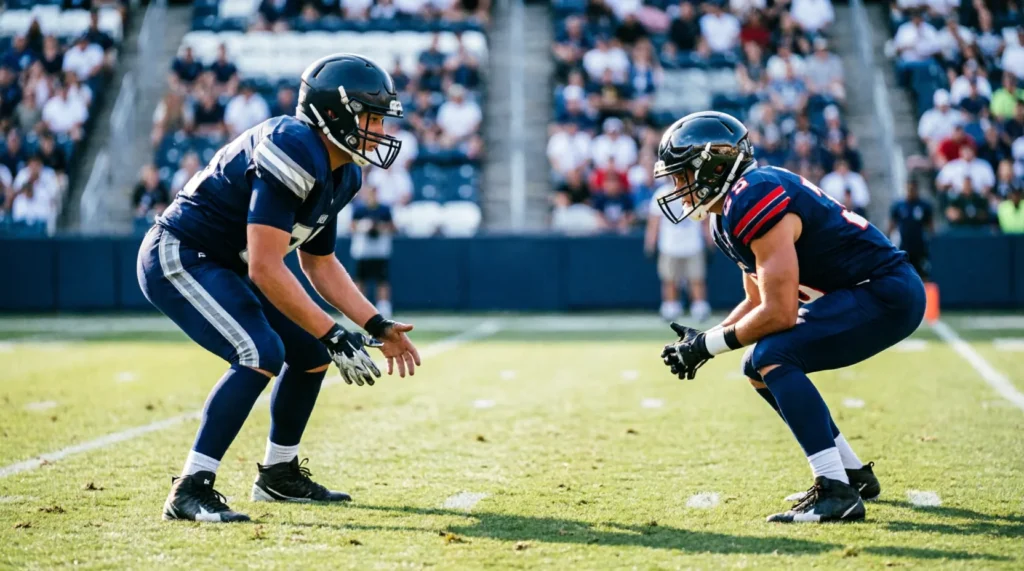
Quick answer: In American football, a cornerback is a defensive back who primarily covers wide receivers on the outside edges of the field, while a safety is a defensive back who plays deeper in the secondary to provide help over the top and stop big plays. They are distinct positions with different responsibilities, though both belong to the defensive backfield.
Many casual fans and new viewers of American football struggle to distinguish between the various players in the defensive backfield. The terms “safety” and “cornerback” are often used interchangeably by those unfamiliar with the sport’s intricate tactical nuances, leading to confusion when analyzing game footage or discussing strategy. Understanding the specific roles of these two positions is essential for anyone looking to deepen their appreciation of how defenses operate against modern passing attacks.
| Term | Meaning / When to use | Example sentence |
|---|---|---|
| Cornerback | A defensive player who lines up near the line of scrimmage to cover wide receivers man-to-man or play zone coverage on the outer edges of the field. | The cornerback broke up the pass by staying step-for-step with the speedy receiver on the sideline. |
| Safety | A defensive player who lines up deep in the secondary, acting as the last line of defense to prevent long touchdowns and support run defense. | The free safety read the quarterback’s eyes and intercepted the deep ball before it reached the tight end. |
When to use Cornerback
The term “cornerback” refers to a specific position within the defensive secondary that is primarily responsible for covering the offense’s wide receivers. As noted in detailed positional analyses, cornerbacks typically line up on the outer edges of the defensive formation, directly opposite the wide receivers Cornerback. Their primary objective is to prevent the receiver from catching the ball, either by sticking with them in man-to-man coverage or by guarding a specific area of the field in zone coverage.
Cornerbacks are often among the fastest and most agile players on the defensive side of the ball. Because they frequently engage in one-on-one battles with elite athletes, they must possess exceptional footwork, hip flexibility, and hand-eye coordination. When you see a defender shadowing a receiver from the snap of the ball until the play ends, you are likely watching a cornerback in action.
Here are common scenarios where the term “cornerback” is appropriately used:
- Man-to-Man Coverage: “The starting cornerback was tasked with shutting down the opposing team’s number one receiver, following him wherever he went on the route tree.”
- Press Coverage at the Line: “By using press technique, the cornerback disrupted the timing of the slant route, forcing the quarterback to hold the ball longer than intended.”
- Turnover Creation: “After deflecting the pass at the line of scrimmage, the cornerback scooped up the loose ball and returned it for a significant gain.”
In practical writing or commentary, you would use “cornerback” when discussing external coverage, boundary defense, or individual matchups against wideouts. For instance, in a fantasy football analysis, you might write, “Avoid starting wide receivers who are matched up against this team’s elite cornerback, as he has allowed the fewest completions in the league this season.”
When to use Safety
The term “safety” describes a defensive back who plays deeper in the field than the cornerbacks, serving as the central pillar of the secondary. Safeties are generally divided into two sub-roles: the free safety and the strong safety. The free safety is often considered the “quarterback of the defense,” reading the offensive formation and providing help over the top against deep passes. The strong safety typically plays closer to the line of scrimmage and is more involved in stopping the run and covering tight ends or slot receivers.
the distinction lies in the depth and scope of responsibility Difference. While cornerbacks focus on specific receivers, safeties focus on the overall integrity of the defensive scheme. They are the last line of defense; if a receiver beats a cornerback, the safety is there to prevent a touchdown.
You should use the term “safety” in the following contexts:
- Deep Zone Coverage: “The free safety drifted back into center field, ensuring that no receiver could get behind the defense for an easy six points.”
- Run Support: “The strong safety flew down from the secondary to tackle the running back in the hole, preventing a first down.”
- Defensive Leadership: “As the veteran safety, he called out adjustments at the line of scrimmage to ensure the linebackers were properly aligned against the spread formation.”
In a scouting report, you might observe, “This prospect lacks the elite speed to play cornerback but possesses the instincts and tackling ability to thrive as a strong safety in a box-heavy defensive scheme.” This highlights the physical and mental traits associated with the safety position compared to the pure coverage skills required of a cornerback.
How to remember the difference
Remembering the distinction between these two positions can be simplified by focusing on their alignment and primary targets. A useful mnemonic is: “Corners cover the corners; Safeties save the day.”
Cornerbacks start near the “corners” or edges of the field. Their job is narrow and specific: handle the guy lined up outside. If you imagine the field as a rectangle, the cornerbacks are protecting the vertical sidelines.
Safeties, on the other hand, are the “saviors” of the defense. They play deep because they are the backup plan. If the primary coverage fails, the safety is there to save the touchdown. Think of them as the insurance policy. You hope you don’t need them to make a play, but when you do, they are critical.
Another way to visualize it is by looking at the depth of the lineup. In a standard defensive formation, the defensive line is at the front, followed by linebackers, then cornerbacks on the sides, and finally safeties in the very back. If you are watching a replay and see a player starting 10–15 yards off the line of scrimmage in the middle of the field, that is almost certainly a safety. If you see a player lining up directly across from a wide receiver, just a few yards from the sideline, that is a cornerback.
Common mistakes and exceptions
One of the most frequent errors made by new fans is assuming that all defensive backs are the same. While they share the general category of “secondary,” their skill sets diverge significantly. Cornerbacks require elite lateral quickness and recovery speed to stay with fast receivers. Safeties require better tackling ability, vision, and range to cover large swaths of the field. Confusing the two can lead to misunderstandings when evaluating player performance. For example, criticizing a safety for not covering a receiver tightly on the line is unfair, as that is not their assigned role.
Another common mistake involves the hybrid roles seen in modern NFL defenses. With the rise of slot receivers and versatile tight ends, some teams employ “nickel” or “dime” packages where a third or fourth cornerback might enter the game. In these situations, a player listed as a cornerback on the roster might actually be playing a role that resembles a slot cornerback, which shares some responsibilities with a safety, such as reading the quarterback and helping in the middle. However, the fundamental distinction remains: if they are lined up wide, they are functioning as a corner; if they are lined up deep or in the box, they are functioning as a safety.
There are also exceptions in terminology based on regional or historical contexts. In some older defensive schemes, the terms “strong safety” and “weak safety” were used more rigidly. Today, the distinction is often blurred by “positionless” defenses where players rotate freely. Nevertheless, for the purpose of clear communication and accurate analysis, maintaining the standard definition is crucial.
Consider this real-world editing scenario: I once reviewed a sports blog post where the author wrote, “The safety jammed the receiver at the line of scrimmage.” This is technically possible if a safety is blitzing or playing an unusual press role, but it is highly uncharacteristic. The correct phrasing should have been, “The cornerback jammed the receiver at the line of scrimmage,” as pressing at the line is a hallmark technique of cornerbacks, not safeties. Correcting this ensures the reader understands the tactical nuance of the play.
Another example comes from resume writing for aspiring coaches. A candidate might list, “Managed secondary units, including safeties and cornerbacks.” If they instead wrote, “Managed defensive backs,” it is vague. Specifying the positions demonstrates a deeper understanding of the distinct coaching requirements for each group. Cornerbacks need drill work on footwork and mirroring; safeties need film study on offensive tendencies and run fits.
Frequently Asked Questions
Can a cornerback play safety? Yes, many players transition from cornerback to safety later in their careers as they lose a step of speed but gain experience and tackling proficiency. This is a common career path in the NFL.
Which position is harder to play? Both are difficult but in different ways. Cornerback is often considered mentally tougher due to the constant one-on-one isolation and high risk of giving up big plays, while safety requires greater physicality and complex diagnostic skills to read the entire offense.
Do safeties ever cover wide receivers? Yes, particularly in zone coverage or when matching up against tight ends and slot receivers. However, they rarely cover the primary outside wide receiver in man-to-man coverage unless specifically schemed to do so.
How many safeties are on the field at once? Typically, two safeties are on the field in a base defense (4-3 or 3-4), known as a “two-high” look. However, defenses may vary this to one safety (“single-high”) or even zero safeties in aggressive blitz packages.

Tyler Miller is an enthusiastic language analyst with a focus on word comparisons who has spent the past five years contributing to WhichWordHub with insightful content. Graduating with a degree in English Language and Linguistics from the University of Michigan, Tyler quickly developed a keen interest in how subtle differences in word choice can alter meaning and tone. Prior to his current role, he worked as a freelance writer and language tutor, where he gained valuable insights into the varied challenges learners face with English vocabulary. His passion for helping others understand these subtleties inspired him to write extensively on word distinctions and their practical applications. Tyler’s articles often emphasize context-driven language use and the importance of selecting the right word to convey the intended message accurately. He is committed to guiding readers through the complex web of English vocabulary, offering clear explanations and real-world examples to enhance their linguistic proficiency.