

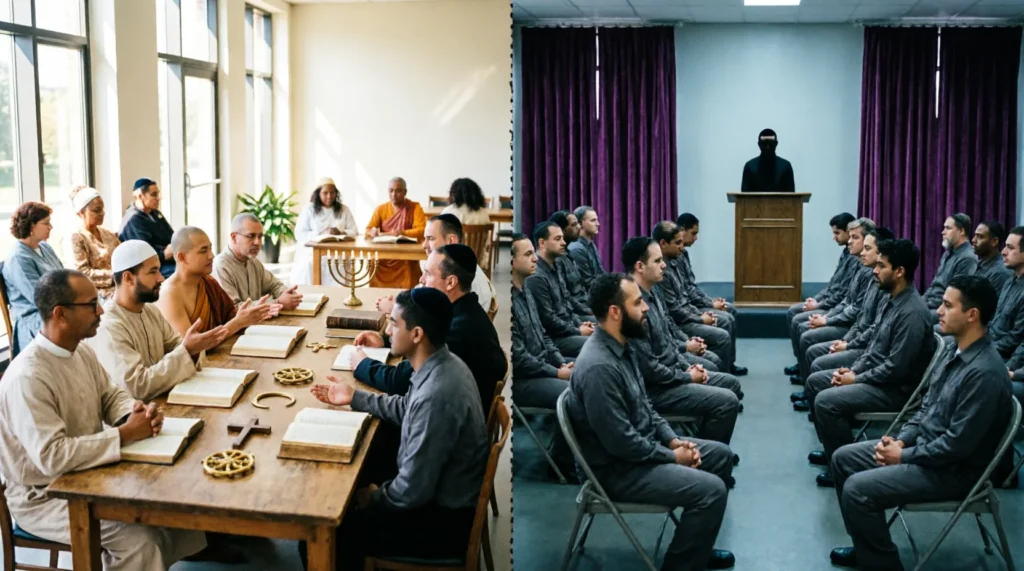
Quick answer: The difference between religion and cult is not about theology, but about behavior and structure. A religion offers community, transparency, and personal freedom, while a cult demands absolute obedience, isolates members from outsiders, and centers on a single living leader who cannot be questioned.
People often confuse these two terms because both involve groups of people sharing beliefs, rituals, and a sense of purpose. However, the distinction is critical for understanding social dynamics, personal safety, and historical context. While Religion is a broad, established system of faith that has existed for millennia, the term “cult” describes a specific, often harmful method of control. Understanding this distinction helps individuals recognize healthy spiritual communities versus those that may pose a risk to their autonomy and well-being.
| Term | Meaning / When to use | Example sentence |
|---|---|---|
| Religion | An organized collection of beliefs, cultural systems, and worldviews that relate humanity to spirituality. It is typically transparent, established, and allows for questioning. | “She found comfort in her religion, which encouraged community service and open dialogue among its members.” |
| Cult | A group with novel religious beliefs and practices, often characterized by excessive devotion to a charismatic leader, isolation from society, and manipulative control tactics. | “The investigative journalist exposed the group as a cult after discovering they confiscated members’ passports and banned contact with family.” |
When to use Religion
Use the term religion when referring to an established, structured system of faith that operates within societal norms and legal frameworks. Religions are typically centuries or millennia old, have standardized texts, and allow for a diversity of interpretation among their followers. They do not require members to cut ties with their past lives, families, or non-believing friends.
Religion involves a complex set of rituals, ethics, and metaphysical beliefs that connect individuals to something greater than themselves. Crucially, mainstream religions generally encourage critical thinking and do not punish dissent with expulsion or shunning.
Here are examples of how to correctly identify religious structures:
- Transparency in Leadership: In a religion, leaders are accountable to a broader hierarchy or congregation. For example, a pastor, rabbi, or imam can be questioned by their peers or removed if they violate ethical standards.
- Example: “The church council voted to replace the minister after he mishandled funds, demonstrating the accountability inherent in the organization.”
- Freedom of Exit: Members of a religion can leave without fear of harassment, threats, or loss of family connections. Leaving may be sad, but it is not dangerous.
- Example: “After years of attending synagogue, David decided to step away from formal practice, and his family continued to invite him to holiday dinners without judgment.”
- Integration with Society: Religious groups often engage with the wider community through charity, education, and public service. They do not view the outside world as inherently evil or dangerous.
- Example: “The local mosque organized a food drive that welcomed volunteers from all faiths, reinforcing their role as a positive community pillar.”
When to use Cult
Use the term cult when describing a group that exhibits high-control behaviors, particularly those centered around a living, charismatic leader who claims exclusive access to truth or salvation. The word “cult” is not just a label for a small or unusual religion; it is a descriptor for a specific dynamic of exploitation and manipulation. Sociologists and psychologists often use the BITE model (Behavior, Information, Thought, and Emotional control) to identify these groups.
The key differentiator is the presence of coercive control. In a cult, the leader’s word is law, and questioning is treated as betrayal. These groups often isolate members from their support networks to make them more dependent on the group for validation and survival.
Here are examples of how to correctly identify cult-like structures:
- Charismatic, Unaccountable Leader: The group revolves around a single individual who claims special powers, divine status, or unique knowledge. This leader is never wrong and cannot be criticized.
- Example: “When Sarah asked why the leader needed a new luxury car, she was publicly shamed for her ‘lack of faith’ and assigned extra labor duties.”
- Isolation and Us-vs-Them Mentality: The group teaches that the outside world is corrupt, evil, or doomed. Members are discouraged or forbidden from interacting with non-members, including family and old friends.
- Example: “Mark stopped answering his sister’s calls because the group taught him that his family was ‘suppressing his spiritual awakening’ and trying to pull him back into darkness.”
- Exploitation of Resources: Members are pressured to give significant amounts of money, time, or labor to the group, often under the guise of spiritual advancement. This can include working for free for the leader’s businesses.
- Example: “Jenna worked 80 hours a week at the group’s organic farm without pay, believing that her exhaustion was a sign of her dedication to the cause.”
How to remember the difference
Remembering the difference between religion and cult can be simplified by focusing on the concept of freedom versus fear.
A helpful mnemonic is “OPEN” vs. “CLOSED”:
Religion is OPEN:
- Open to questions and doubt.
- Public about finances and leadership decisions.
- Encourages connections with family and outsiders.
- No penalty for leaving.
Cult is CLOSED:
- Controls information and restricts access to outside news.
- Leader is above criticism and accountability.
- Ostracizes those who leave or question.
- Secretive about true goals and finances.
- Exploits members’ resources and labor.
- Demand for absolute loyalty and conformity.
Another editor-level insight is to look at the exit door. In any healthy organization, including religious ones, the exit door is unlocked. You can walk out whenever you choose. In a cult, the exit door is locked, guarded, or mined with emotional explosives. If you feel afraid to leave because of what might happen to your soul, your family, or your safety, you are likely dealing with a cult, not a religion.
Common mistakes and exceptions
One common mistake is assuming that size determines whether a group is a cult. Many people believe that only small, fringe groups can be cults. However, history shows that large organizations can also exhibit cult-like behaviors. Conversely, some small, new religious movements are benign and do not use manipulative tactics. The size of the group is less important than the methods of control it employs. For more, see Difference.
Another frequent error is using “cult” as a synonym for “weird” or “unfamiliar.” Just because a religious practice is unusual, involves strange rituals, or has unconventional beliefs does not make it a cult. Many mainstream religions have origins that seemed bizarre to outsiders at the time. The defining feature of a cult is not the content of the belief, but the context of the behavior. If a group believes the world will end next Tuesday but allows you to keep your job, talk to your parents, and keep your bank account, it is an unusual religious group, not necessarily a cult.
It is also important to note the academic shift in terminology. Scholars of religion often prefer the term “New Religious Movement” (NRM) to avoid the pejorative stigma of “cult.” However, in common usage and psychological contexts, “cult” remains the standard term for high-control groups. When writing or speaking, be aware that calling a group a “cult” is a serious accusation based on behavioral evidence, not just theological disagreement.
In the US vs. UK context, the definition remains largely consistent, though legal frameworks differ. The US has strong protections for religious freedom, making it harder to legally dismantle cults unless they commit clear crimes like fraud or abuse. The UK and other European countries may have stricter laws regarding charitable status and financial transparency, which can sometimes provide more leverage against exploitative groups.
Frequently Asked Questions
Can a religion turn into a cult? Yes, if a religious group gradually adopts high-control tactics, centralizes power around a single unaccountable leader, and begins isolating members from outside influences, it can transition into what experts define as a cult. This often happens slowly over years.
Is it illegal to be part of a cult? No, being a member of a cult is not illegal in most democratic countries, including the US and UK. Freedom of religion protects the right to hold unusual beliefs. However, illegal activities committed by cult leaders, such as fraud, abuse, or kidnapping, are prosecutable crimes.
What is the main psychological tool cults use to keep members? Cults primarily use “love bombing” initially—overwhelming new recruits with affection and attention—to create a sense of belonging. Once attached, they switch to intermittent reinforcement and fear-based control, making members feel they cannot survive or find worth outside the group.
How can I help someone who is in a cult? The most effective approach is to maintain a non-judgmental, open line of communication. Avoid attacking the group or the leader directly, as this often causes the member to defend them. Instead, ask open-ended questions that encourage critical thinking and remind them of their life and identity before joining the group. Professional interventionists specializing in cult exit counseling are also recommended.

Tyler Miller is an enthusiastic language analyst with a focus on word comparisons who has spent the past five years contributing to WhichWordHub with insightful content. Graduating with a degree in English Language and Linguistics from the University of Michigan, Tyler quickly developed a keen interest in how subtle differences in word choice can alter meaning and tone. Prior to his current role, he worked as a freelance writer and language tutor, where he gained valuable insights into the varied challenges learners face with English vocabulary. His passion for helping others understand these subtleties inspired him to write extensively on word distinctions and their practical applications. Tyler’s articles often emphasize context-driven language use and the importance of selecting the right word to convey the intended message accurately. He is committed to guiding readers through the complex web of English vocabulary, offering clear explanations and real-world examples to enhance their linguistic proficiency.