

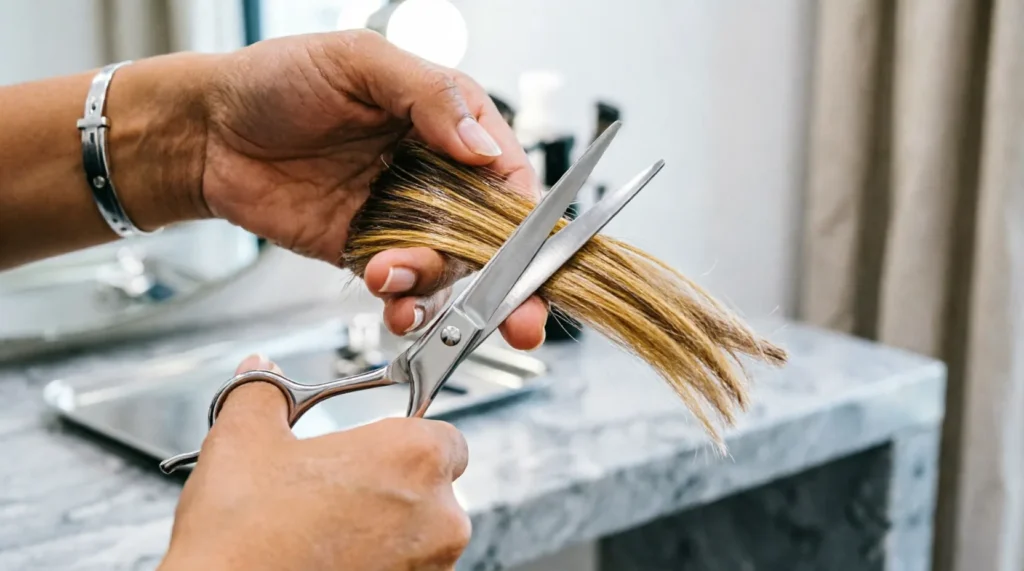
Quick answer: In most professional salon scenarios, you should color your hair first and cut it second. Coloring first allows the stylist to see the natural fall, texture, and dimension of the hair, ensuring the final cut perfectly frames the new highlights or solid color. However, if you are making a drastic length change or removing severely damaged, brittle ends, cutting first is the necessary and non-negotiable exception.
The debate over whether to cut or color hair first is one of the most common dilemmas clients face when booking a salon appointment. This confusion stems from the fact that both processes fundamentally alter the hair’s physical structure and visual appearance, making the sequence seem entirely interchangeable to the untrained eye. Many clients assume that because both services happen in the same chair, the order is merely a matter of stylist preference or salon scheduling convenience. Understanding the correct, scientifically backed order is crucial, as it directly impacts the long-term health of your hair, the precision of the stylist’s technical work, and the overall longevity and vibrancy of your final look. Getting the sequence wrong can lead to wasted product, uneven color absorption, and a haircut that fails to showcase your new color.
| Term | Meaning / When to use | Example sentence |
|---|---|---|
| Color hair first | The standard professional protocol where chemical treatments, lighteners, or dyes are applied before the haircut, allowing the stylist to strategically cut around the newly placed dimension. | “My stylist recommended we color my hair first so she could see exactly where the balayage fell before trimming the ends.” |
| Cut hair first | The strategic exception used when a client is making a drastic length change or needs to remove heavily damaged, split ends before applying costly chemical treatments. | “Because I was going from waist-length to a bob, we decided to cut my hair first to avoid wasting expensive dye on lengths I was going to discard.” |
When to color hair first
Coloring hair first is the undisputed gold standard in the professional cosmetology industry for a multitude of structural, chemical, and aesthetic reasons. When a stylist applies color, bleach, or highlights, they are not just changing the hue; they are actively adding visual weight, dimension, and texture to the hair shaft. According to the foundational principles of Color, the way light interacts with pigmented surfaces creates depth and perception. In advanced hair design, this means that highlights, lowlights, and color melts will catch the ambient light differently depending on the exact angle, layering, and length of the individual strand. If a haircut is performed before the color is applied, the stylist is essentially cutting blind. They cannot accurately anticipate how the newly added dimensional color will shift the visual weight and movement of the hairstyle.
Furthermore, the chemical process of coloring slightly but significantly alters the hair’s physical texture. Bleach, for instance, lifts the protective cuticle layer and can make the hair feel slightly more porous, expanded, or textured. A highly skilled stylist uses this post-color texture to their distinct advantage, refining the haircut to blend seamlessly with the hair’s new behavioral patterns. For example, a blunt, one-length bob might look incredibly sharp and severe on virgin, unprocessed hair. However, after a subtle glossing treatment or a light balayage, those same ends might benefit from a slight point-cutting technique to soften the line, remove any residual bulk, and enhance the overall shine of the newly pigmented strands.
Consider this real-world scenario from a client’s email to their salon:
- Incorrect request: “I want to cut my hair into heavy layers first, then get a full head of balayage.”
- Corrected request: “I want to get a full head of balayage first, then have my hair cut into layers to perfectly frame the new dimension.”
The correction is vital because if the stylist cuts the heavy layers first, they might inadvertently trim away the very sections that were meant to be lightened. Worse, they might leave heavy, uncolored chunks of virgin hair that completely disrupt the soft, sun-kissed flow of the new balayage. By coloring first, the stylist can meticulously paint the lightener, process it, rinse it, and then evaluate the exact placement of the brightest, most expensive pieces. The subsequent haircut then acts as a precise framing device, carving out layers that deliberately expose those newly created highlights, ensuring the client gets the absolute maximum visual impact and return on investment from their chemical service.
When to cut hair first
While coloring first is the default rule, there are specific, non-negotiable scenarios where cutting hair first is the only logical, professional choice. The primary rule here is beautifully simple: never pay a premium to color hair that is inevitably going to end up on the salon floor. If a client is requesting a drastic, transformative change, such as chopping off twenty inches of length to achieve a chic pixie cut or a sharp, chin-length bob, the bulk of that hair must be removed before any color is even mixed in the bowl.
This approach is also critically important when dealing with compromised hair integrity. Severely damaged, brittle, or heavily split ends do not hold color evenly or predictably. The porous, frayed ends will absorb dye much faster and more intensely than the healthier mid-lengths and roots, resulting in a patchy, uneven, muddy, or overly dark outcome that is incredibly difficult to correct. By cutting the hair first, the stylist removes these compromised, unpredictable sections, creating a clean, uniform, and healthy canvas. This ensures that the subsequent color application processes evenly from root to tip, yielding a smooth, predictable, and vibrant result that the client can easily maintain at home.
Let us look at a practical text message exchange with a stylist to illustrate this:
- Incorrect text: “Can u cut 3 inches off before coloring tomorrow?”
- Corrected text: “Since I’m dropping 12 inches, can we cut first to remove the damage, then color the new length?”
This distinction matters immensely because a standard 3-inch maintenance trim should almost always happen after the color service. However, a 12-inch chop is a massive structural change that fully justifies cutting first to avoid wasting expensive, high-quality dye on lengths destined for the trash bin.
Another example appears in professional salon consultation notes:
- Incorrect note: “Client desires color then cut for a major 15-inch length reduction.”
- Corrected note: “Client desires cut first to remove 15 inches, then single-process color to avoid product waste.”
As noted in discussions of procedural sequence, doing something first establishes the foundation for all subsequent steps. When the foundation is a massive structural change, the cut must precede the color to guarantee both economic efficiency and aesthetic precision.
How to remember the difference
Remembering whether to cut or color hair first can be simplified with a single, editor-level mnemonic that any client can use: “Paint the Canvas, Then Frame the Picture.”
Think of your head of hair as a blank, textured canvas. The colorist is the painter, adding depth, shadow, and light to create a multidimensional masterpiece. The haircut is the frame. You would never build a custom, intricately carved, expensive frame before knowing the exact dimensions, orientation, and focal points of the painting it is meant to hold. By coloring first, you allow the “paint” to dry, settle, and reveal the true focal points of the design. The subsequent haircut then “frames” those specific highlights, face-framing pieces, or color melts, ensuring the final presentation is cohesive, intentional, and flattering to your face shape.
Another practical, foolproof trick is the “Floor Test.” Before your appointment, ask yourself a simple question: “Is a significant, noticeable amount of hair going to hit the salon floor?” If the answer is a definitive yes, you should cut first to save money and avoid coloring dead, damaged ends. If the answer is no, meaning it is just a routine trim, dusting, or minor shape-up, you should color first to allow the stylist to tailor the cut precisely to your new dimension.
Common mistakes and exceptions
Even with clear, professional guidelines, misconceptions persist among salon clients. One of the most frequent mistakes clients make is assuming that a “trim” is too minor to warrant the “color first” rule. In reality, even a conservative half-inch trim can drastically alter how a delicate, face-framing highlight sits against the cheekbone. If the stylist cuts that half-inch off before coloring, they might accidentally snip off the brightest, most expensive part of the balayage, leaving the client with a muted, less impactful, and disappointing result. Always default to color first for routine maintenance trims.
Another common pitfall involves corrective color scenarios. If a client is coming in to fix a botched, uneven at-home box dye job, the stylist may need to cut the hair first if the ends are severely compromised by overlapping, unprofessional bleach applications. In the salon, health always trumps aesthetics; no amount of beautiful, expensive color can fix or save hair that is actively stretching and breaking off.
Another detail to consider is the regional spelling differences that can cause minor confusion in online searches or digital salon booking forms. In the United States, the term is universally spelled “color,” leading to common search queries like “cut or color hair first.” In the United Kingdom, Canada, and Australia, the correct spelling is “colour,” making the query “cut or colour hair first.” While the spelling differs geographically, the professional salon protocol remains exactly the same globally: dimension dictates the cut, unless drastic length removal is required.
Frequently Asked Questions
Should I wash my hair before my color and cut appointment? It is generally best to arrive with hair that is unwashed for 24 to 48 hours before a color service, as the natural scalp oils protect against chemical irritation, but you should always clarify with your specific stylist regarding the cut.
Can I get a cut and color on the same day? Yes, getting a cut and color on the same day is highly recommended and standard practice, as it allows the stylist to perfectly synchronize the two services for a cohesive, polished, and intentional final result.
What if I am only getting bangs trimmed and a root touch-up? For a minor adjustment like a bang trim combined with a root touch-up, you should still color first, allowing the stylist to see how the new root blend affects the weight, texture, and fall of the bangs before cutting them.
Does the type of color service change the order? Yes, a single-process all-over color might be slightly more forgiving if cut first, but dimensional services like balayage, foilyage, or vivid fashion colors absolutely require the color to be applied first so the stylist can cut around the precise placement.

Tyler Miller is an enthusiastic language analyst with a focus on word comparisons who has spent the past five years contributing to WhichWordHub with insightful content. Graduating with a degree in English Language and Linguistics from the University of Michigan, Tyler quickly developed a keen interest in how subtle differences in word choice can alter meaning and tone. Prior to his current role, he worked as a freelance writer and language tutor, where he gained valuable insights into the varied challenges learners face with English vocabulary. His passion for helping others understand these subtleties inspired him to write extensively on word distinctions and their practical applications. Tyler’s articles often emphasize context-driven language use and the importance of selecting the right word to convey the intended message accurately. He is committed to guiding readers through the complex web of English vocabulary, offering clear explanations and real-world examples to enhance their linguistic proficiency.