

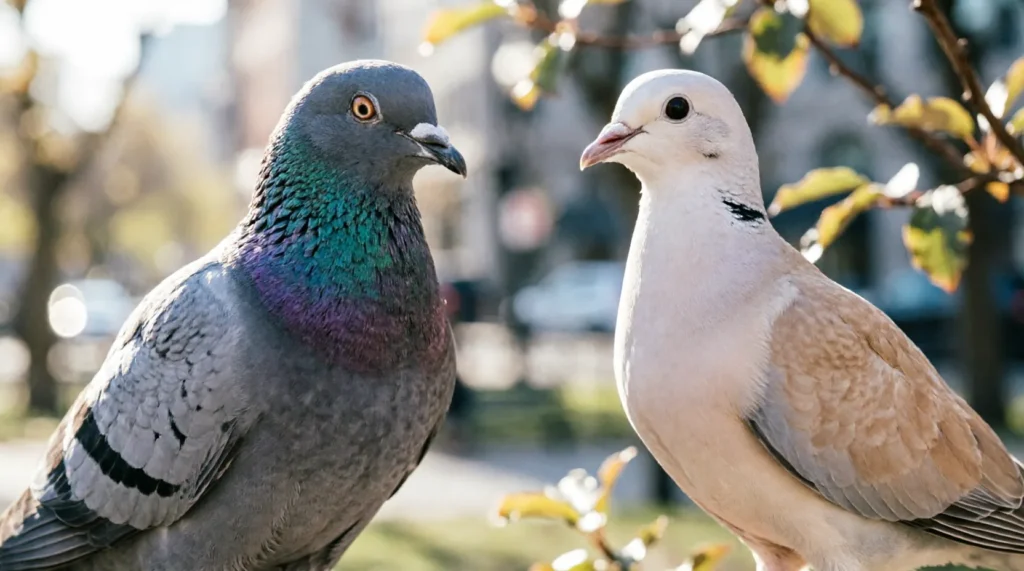
Quick answer: There is no scientific difference between pigeons and doves; they belong to the same family, Columbidae, and the distinction is purely linguistic and cultural rather than biological.
Writers frequently stumble over this pair because English assigns different connotations to two words that describe the exact same taxonomic group. We tend to call smaller, lighter-colored species “doves” and larger, darker ones “pigeons,” but this convention breaks down constantly in both field guides and formal writing. Understanding that this is a language problem, not an ornithology problem, saves you from making false distinctions in everything from nature essays to wedding copy.
| Term | Meaning / When to use | Example sentence |
|---|---|---|
| Pigeon | General term for birds in family Columbidae; often used for larger, urban, or wild-type specimens | The city council installed spikes to deter pigeons from roosting on the library ledge. |
| Dove | Same biological family as pigeon; typically reserved for smaller species, domesticated white varieties, or symbolic contexts | The couple released a pair of white doves after exchanging vows at the garden ceremony. |
When to Use Pigeon
Use “pigeon” when referring to the bird in biological, ecological, or municipal contexts where size, behavior, or taxonomy matters more than symbolism. This is the default scientific and neutral term for members of the family Columbidae, especially when discussing wild populations, pest management, or natural history. As explained in the entry on Difference, many supposed distinctions between terms are actually artifacts of human categorization rather than reflections of underlying reality, and the pigeon/dove split is a textbook example of this phenomenon.
- The wildlife rehabilitator specialized in treating injured pigeons found near downtown transit hubs.
- My biology textbook explained that rock pigeons were among the first animals domesticated by humans thousands of years ago.
- The restaurant owner complained about pigeons nesting above the outdoor dining patio.
In professional editing, I see writers incorrectly swap in “dove” when describing urban bird control or veterinary care because they think “pigeon” sounds too harsh. Resist this impulse. If your subject is a feral Columba livia eating crumbs on a sidewalk, “pigeon” is the precise word. Using “dove” here creates tonal dissonance and signals to knowledgeable readers that you don’t understand your subject matter.
The term also applies correctly to specific named species regardless of size. The band-tailed pigeon, the wood pigeon, and the passenger pigeon all retain “pigeon” in their common names despite varying dramatically in appearance and habitat. Defaulting to “pigeon” for any non-symbolic reference keeps your prose accurate and avoids unintended poetic overtones.
When to Use Dove
Reserve “dove” for symbolic, ceremonial, religious, or aesthetic contexts where the bird functions as a metaphor for peace, love, purity, or the Holy Spirit. This usage is entirely cultural and has no basis in the animal’s actual behavior or genetics. You should also use “dove” when referring to specific small species traditionally called by that name, such as mourning doves, diamond doves, or zebra doves, particularly in birdwatching or pet-trade writing.
- The stained-glass window depicted a dove descending with an olive branch during the Easter service.
- She keeps a pair of diamond doves in an indoor aviary because they are quieter than parrots.
- The poet described her grief lifting like a dove released into morning light.
I recently edited a memoir where the author wrote “a flock of doves gathered around the dumpster behind the fish market.” Every reader familiar with urban ecology immediately pictured pigeons, not the ethereal creatures the sentence demanded. The fix was simple: change “doves” to “pigeons.” Save “dove” for moments when symbolism is intentional and earned, not accidental.
When writing about the pet trade or aviculture, follow established common names even if they seem arbitrary. A “ring-necked dove” sold in pet stores is biologically identical to what scientists might classify under Streptopelia risoria, but calling it a “pigeon” in a care guide would confuse buyers searching for that specific product. Here, convention trumps etymology, and your job as a writer is to match reader expectations.
The symbolic weight of “dove” makes it powerful but dangerous in technical writing. Never use it in scientific papers, environmental impact statements, or veterinary records unless quoting historical or literary sources. Precision requires “pigeon” or the Latin binomial; “dove” introduces ambiguity that peer reviewers will flag immediately.
How to Remember the Difference
The most reliable memory trick comes from understanding that the distinction lives entirely in human language, not in nature. Think of it this way: if you can hold the bird without thinking about peace treaties, weddings, or biblical verses, write “pigeon.” If the bird exists primarily as a symbol in your sentence, write “dove.” This heuristic works because it mirrors how native speakers actually deploy these words across centuries of text.
Another editor’s test involves substitution. Try replacing the word with “Columbidae member.” If the sentence still makes sense and loses nothing essential, “pigeon” was probably correct. If the replacement destroys the intended meaning or emotional resonance, you needed “dove.” For example, “The artist painted a Columbidae member holding an olive branch” reads like a biology caption, not art criticism. That failure confirms “dove” was necessary.
I teach junior copywriters to associate “pigeon” with concrete nouns (sidewalks, ledges, droppings, seeds) and “dove” with abstract nouns (peace, hope, spirit, grace). This sensory anchor prevents the most common errors in lifestyle and marketing content. When your draft mentions feathers on pavement, trust the pigeon association. When it mentions transcendence, trust the dove association. The physical world belongs to pigeons; the metaphorical world belongs to doves. For more, see Between.
This mnemonic also helps catch overcorrection. Some writers, having learned that “there’s no real difference,” start using “pigeon” everywhere to sound scientifically rigorous. But language serves communication, not just taxonomy. Calling the Holy Spirit a “pigeon” isn’t more accurate—it’s tone-deaf. The goal is appropriate register, not pedantic uniformity.
Common Mistakes and Exceptions
The most frequent error I correct in manuscripts is assuming color determines the term. White does not automatically equal dove, nor does gray automatically equal pigeon. Albino pigeons exist, and some dove species are dark brown or mottled. Base your word choice on context and species convention, never on plumage alone. A white rock pigeon released at a magic show is still a pigeon; calling it a dove misleads audiences about what animal they’re seeing.
Regional dialects create additional traps. In British English, “wood pigeon” refers to Columba palumbus, while Americans might call similar birds “band-tailed pigeons.” Meanwhile, “turtle dove” appears in Christmas carols and biblical translations but refers to Streptopelia turtur, a migratory species now rare in Britain. Always verify which regional convention your audience expects before finalizing terminology. What sounds natural in one dialect may signal ignorance in another.
Historical texts compound the confusion. Older literature uses “dove” far more broadly than modern writing, including references to birds we’d now unambiguously call pigeons. When editing period pieces or quoting vintage sources, preserve original usage rather than “correcting” it to contemporary standards. However, in new writing, adhere to current conventions unless deliberately evoking archaic tone. Anachronistic diction distracts readers just as much as factual errors.
Scientific naming provides the ultimate exception handler. When precision is non-negotiable, bypass the vernacular entirely and use Latin binomials. Columba livia domestica covers every white release bird whether marketers call them doves or pigeons. Streptopelia decaocto identifies the Eurasian collared-dove unambiguously across languages. In academic, legal, or regulatory writing, this eliminates the entire debate. Reserve English terms for general audiences who benefit from accessible language.
One subtle exception involves culinary contexts. Squab, the meat of young pigeons, is never marketed as “dove meat” despite coming from the same family. Restaurant menus and food writing maintain this distinction rigorously. Writing “braised dove” instead of “squab” suggests either exotic game or mistranslation. Food terminology follows its own traditions that override both biological accuracy and symbolic associations.
Frequently Asked Questions
Are white pigeons and doves the same bird? Yes, white “release doves” used at weddings and events are typically domesticated rock pigeons bred for pale plumage and homing instinct. They are biologically identical to gray city pigeons, distinguished only by selective breeding and marketing terminology.
Why do we have two words for the same animal? English inherited “dove” from Old English and borrowed “pigeon” from French after the Norman Conquest, creating a class-based lexical split similar to cow/beef or sheep/mutton. Over centuries, “dove” accrued sacred and poetic associations while “pigeon” became the everyday term, cementing a distinction that never existed in nature.
Is it wrong to call a mourning dove a pigeon? Technically accurate but socially misleading, since “mourning dove” is the established common name recognized by birders and field guides. Using “pigeon” for this specific species suggests unfamiliarity with North American birding conventions, even though the bird belongs to the same family as urban pigeons.
Do other languages distinguish pigeons from doves? Many languages use a single root word for both, reflecting the biological unity that English obscures through historical accident. Spanish uses “paloma” for both, German uses “Taube,” and Mandarin uses “鸽子,” demonstrating that our dual terminology is culturally specific rather than universally intuitive.

Steven Garcia has dedicated over a decade to exploring the intricacies of the English language, specializing in word comparisons and nuanced linguistic distinctions. Holding a master’s degree in Linguistics from the University of California, Steven has always been fascinated by the dynamic evolution of language. He began his career as an editor for several publishing houses, where he honed his skills in discerning subtle differences in word usage. Steven is particularly interested in the etymology and historical contexts that shape word meanings. His passion for language led him to join WhichWordHub, where he focuses on creating insightful content that helps readers understand the subtle differences between similar words. Through his work, Steven aims to enrich the vocabulary of language enthusiasts and empower them to make informed word choices. In addition to writing detailed articles, he enjoys engaging with the linguistic community to discuss the ever-evolving nature of English.