

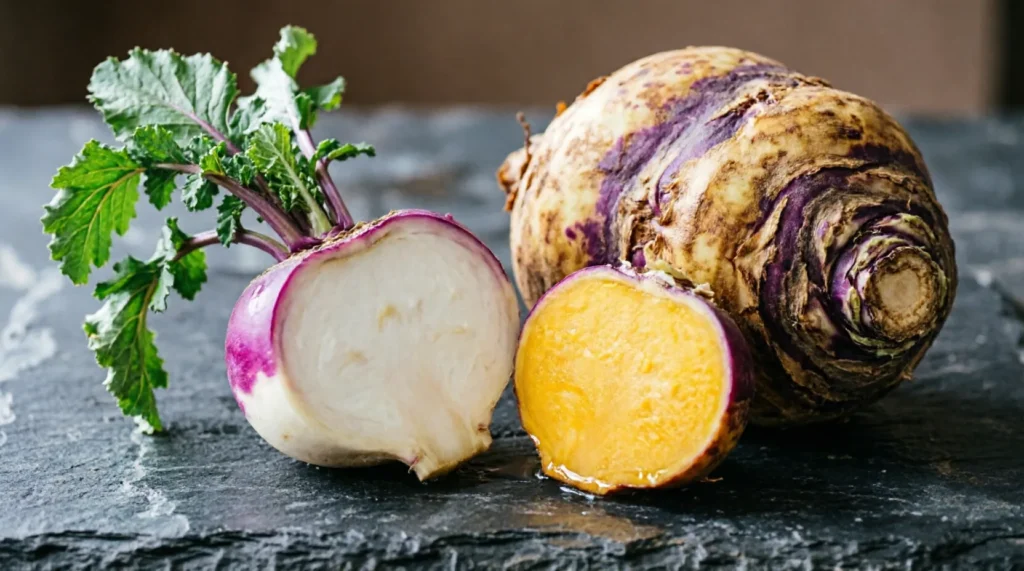
Quick answer: Rutabagas are larger, sweeter, and have yellow-orange flesh with a purple-tan skin, while turnips are smaller, sharper-tasting, and have white flesh with purple-white skin. Rutabagas take longer to mature and are actually a cross between turnips and cabbage.
If you’ve ever stood in the produce aisle scratching your head over two similar-looking root vegetables, you’re not alone. Rutabagas and turnips look remarkably alike at first glance—both are round, root vegetables with purple-tinged skin. But these are two distinct vegetables with different flavors, cooking times, and nutritional profiles. Understanding the difference between rutabaga and turnip will save your recipe from disaster and help you choose the right vegetable for your dish.
Quick Comparison: Rutabaga vs Turnip
| Term | Meaning / When to use | Example sentence |
|---|---|---|
| Rutabaga | A larger, sweeter root vegetable with yellow-orange flesh and purple-tan skin; takes 80-100 days to mature; actually a hybrid of turnip and cabbage | “I roasted the rutabaga with carrots and it caramelized beautifully, taking about 45 minutes to become tender.” |
| Turnip | A smaller, peppery root vegetable with white flesh and purple-white skin; matures quickly in 30-60 days; belongs to the brassica family but is its own species | “The young turnips from the farmers market were so tender I cooked them in just 20 minutes with a bit of butter and honey.” |
What Is a Rutabaga?
Rutabagas (also called swedes or yellow turnips in some regions) are the bigger, sweeter cousins in this vegetable pairing. They’re actually a hybrid cross between turnips and wild cabbage, which explains their more complex flavor profile and larger size. rutabagas have a distinctive yellow-orange flesh that sets them apart visually from their white-fleshed relatives.
Key characteristics of rutabagas:
- Size: Typically 4-6 inches in diameter, weighing 1-3 pounds
- Skin color: Purple-brown or tan on top, yellowish on the bottom
- Flesh color: Distinctive yellow or orange
- Flavor: Sweeter, milder, with hints of cabbage
- Texture: Denser and firmer than turnips
- Cooking time: Longer—usually 30-45 minutes when roasting
- Growing season: Cool weather crop that takes 80-100 days to mature
- Best uses: Roasting, mashing, soups, stews, and casseroles where longer cooking is acceptable
Rutabagas develop their best flavor after a frost, which converts their starches to sugars. This is why they’re often considered a winter vegetable and appear in stores during the colder months. The wax coating you sometimes see on rutabagas in grocery stores isn’t natural—it’s applied to prevent moisture loss during storage, since these vegetables keep well for months in cool conditions.
What Is a Turnip?
Turnips are the quicker-maturing, sharper-tasting root vegetable that’s been cultivated for thousands of years. They’re smaller, faster-growing, and have a more peppery bite compared to rutabagas. Turnips can be eaten at various stages—young turnips are tender and mild enough to eat raw in salads, while mature turnips develop a stronger flavor that benefits from cooking.
Key characteristics of turnips:
- Size: Usually 2-4 inches in diameter, weighing 4-16 ounces
- Skin color: White with purple, red, or greenish blush on top
- Flesh color: Pure white (sometimes cream-colored)
- Flavor: Peppery, slightly bitter, with a sharp bite when raw
- Texture: Crisp when raw, becomes tender and creamy when cooked
- Cooking time: Shorter—15-25 minutes when roasting
- Growing season: Fast-growing, matures in 30-60 days; can be planted in spring or fall
- Best uses: Roasting, boiling, mashing, eating raw when young, adding to stir-fries
One of the biggest advantages of turnips is their versatility. Young, small turnips (sometimes called “baby turnips”) are so mild and tender that you can slice them thin and toss them raw into salads. The greens are also edible and nutritious—turnip greens cook up like kale or collard greens and are packed with vitamins. For more, see Rutabagas And Turnips: What’s The Difference?.
How to Tell Them Apart at the Store
Here’s a practical memory trick I use when shopping: “Rutabagas are Rough and Rounder, Turnips are Tiny and Two-toned.”
The size difference is usually the easiest giveaway. If you’re holding a root vegetable that feels hefty—like it could double as a doorstop—it’s probably a rutabaga. Turnips are noticeably smaller and lighter.
Visual identification checklist:
- Check the flesh color: Cut or pre-cut vegetables will show yellow-orange (rutabaga) versus white (turnip)
- Look at the skin: Rutabagas have that waxy, tan-purple appearance; turnips are smoother with distinct purple-white coloring
- Feel the texture: Rutabagas often feel denser and heavier for their size
- Read the label: If it’s waxed, it’s almost certainly a rutabaga
Another editor’s trick: rutabagas almost always have the top portion cut off where the greens were attached, creating a flat surface. Turnips are more likely to be sold with greens still attached (though this varies by store).
Common Mistakes and Cooking Confusion
The most common mistake I see in recipe disasters is substituting these vegetables one-for-one without adjusting cooking time. Because rutabagas are denser and larger, they take significantly longer to cook. If you swap a rutabaga for a turnip in a quick-roast recipe, you’ll end up with crunchy, undercooked chunks.
Real-world cooking mistakes:
Mistake #1: The Undercooked Rutabaga
- Wrong: “I cubed what I thought was a turnip and roasted it for 20 minutes at 400°F, but it was still hard as a rock.”
- Right: That was a rutabaga, which needs 35-45 minutes at that temperature. Next time, cut it smaller or increase cooking time.
Mistake #2: Expecting Sweetness from Turnips
- Wrong: “My turnip mash tasted bitter and sharp, not sweet like the recipe promised.”
- Right: The recipe probably meant rutabaga, which has natural sweetness. Turnips are peppery and benefit from added sweeteners like honey or maple syrup.
Mistake #3: Using Mature Turnips Raw
- Wrong: “I sliced a large turnip into my salad and it was so bitter I couldn’t eat it.”
- Right: Large, mature turnips are too sharp for raw consumption. Use young, small turnips for salads, or cook the larger ones.
Regional naming exceptions:
In some parts of the world, particularly the UK and Commonwealth countries, rutabagas are called “swedes” or “neeps,” which adds another layer of confusion. In Scotland, “neeps” traditionally refers to rutabagas (not turnips), which is why you’ll see “neeps and tatties” (rutabagas and potatoes) served with haggis.
Additionally, some older cookbooks or regional recipes might use “turnip” to refer to rutabagas, especially in American Southern cooking. If a recipe seems off—calling for a “turnip” but describing a long cooking time or yellow flesh—it’s probably actually calling for a rutabaga. For more, see Difference.
Frequently Asked Questions
Can I use rutabaga and turnip interchangeably in recipes?
Not without adjustments. While both are root vegetables, rutabagas take 50-100% longer to cook and have a sweeter, milder flavor. If substituting, cut rutabagas smaller to reduce cooking time, or add sweeteners to turnips to balance their peppery bite.
Which is healthier: rutabaga or turnip?
Both are nutritious, but they have slightly different profiles. Turnips are lower in calories (36 per cup vs. 50 for rutabaga) and higher in vitamin K, while rutabagas pack more vitamin C and potassium. Both are excellent sources of fiber and make healthy additions to any diet.
Why are rutabagas waxed but turnips aren’t?
Rutabagas are often coated with food-grade wax to prevent moisture loss during their long storage period—they can keep for 2-3 months in cool conditions. Turnips have a shorter shelf life (2-4 weeks) and are usually sold fresh, so waxing isn’t necessary. Simply peel the wax off with a vegetable peeler before cooking.
Do rutabagas and turnips taste the same when cooked?
No. Cooked rutabagas become sweet, mellow, and almost buttery with a texture similar to butternut squash. Cooked turnips retain more of their sharp, slightly bitter character, though they do mellow and become creamy. Think of rutabaga as the sweet potato to turnip’s white potato.

Susan Robinson is a seasoned language expert with over 15 years of experience specializing in English word comparisons. With a Ph.D. in English Literature from Oxford University, Susan possesses an in-depth understanding of language nuances and usage. Her academic journey revealed the profound impact of word choice on effective communication, fueling her passion for this niche field. Prior to joining WhichWordHub, Susan taught advanced ESL courses, where she developed innovative methods to clarify word distinctions for non-native speakers. At WhichWordHub, she is dedicated to crafting comprehensive guides that deconstruct complex language concepts into easily digestible information. Her articles often delve into common language pitfalls and provide practical advice on vocabulary enhancement. Susan’s goal is to foster a deeper appreciation for word precision and aid readers in mastering the art of eloquent expression.