

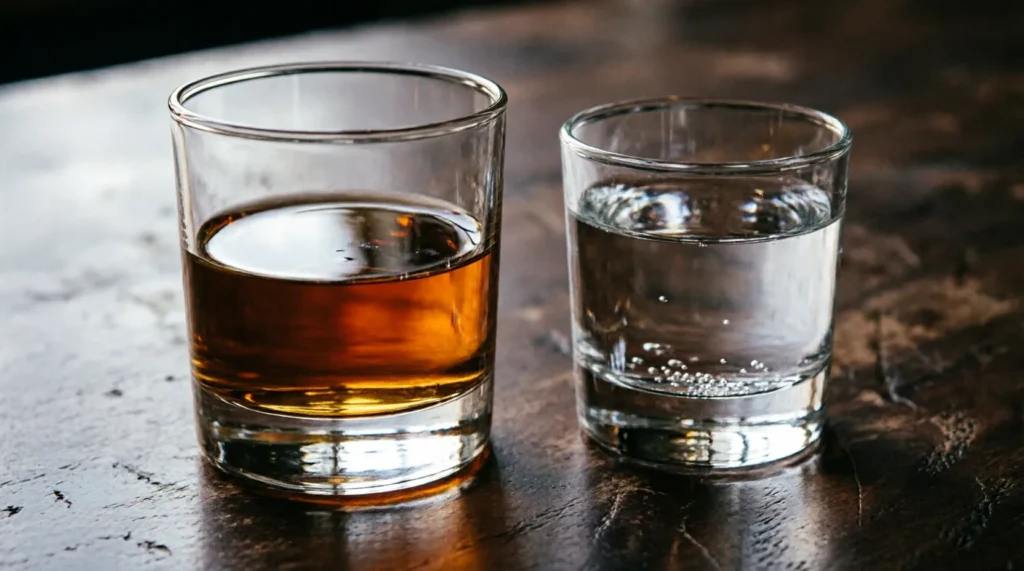
Quick answer: Standard whisky and standard vodka are equally strong, as both are typically bottled at 40% alcohol by volume (ABV). However, whisky frequently reaches higher strengths (up to 60%+ ABV) in cask-strength varieties, making it the objectively stronger spirit in premium or uncut forms.
I see this confusion constantly in bar menus, casual text messages, and even professional hospitality training materials. People often equate the harsh, burning sensation of cheap vodka or the smoky, peaty punch of a single-malt whisky with overall alcohol content. This is a fundamental misunderstanding of distillation and human sensory perception. In reality, determining whether whisky or vodka is stronger requires looking past subjective flavor perception and examining the exact alcohol by volume (ABV) printed on the bottle. The human palate is easily tricked by sweetness, serving temperature, and the presence of congeners, leading many to confidently assert the wrong spirit is the more potent one.
| Term | Meaning / When to use | Example sentence |
|---|---|---|
| Whisky | A distilled grain spirit, typically 40–50% ABV, used when referring to a beverage with complex, often stronger flavor profiles and higher cask-strength potential. | “I ordered the cask-strength whisky because I wanted a genuinely stronger drink than the standard 40% vodka.” |
| Vodka | A neutral distilled spirit, typically 40% ABV, used when referring to a beverage that masks its alcohol content, making it seem less strong than it actually is. | “Do not assume the vodka is weaker; at 40% ABV, it is just as strong as the standard whisky it is mixed with.” |
When to use Whisky
When discussing spirit strength, you reference whisky when addressing beverages that openly display their alcoholic potency through flavor, aroma, and occasional high-proof bottlings. Whisky derives its character from fermented grain mash and aging in wooden casks, processes that can concentrate alcohol over time. According to the comprehensive definition of Whisky, it is a type of distilled alcoholic beverage made from fermented grain mash, often aged in wooden casks which can increase its perceived and actual strength. This aging process is the critical differentiator.
During the maturation period, whisky interacts with the wood of the barrel. In certain climates, the evaporation of water occurs at a higher rate than the evaporation of alcohol, a phenomenon known as the “angel’s share.” This natural process can actually increase the ABV of the spirit inside the cask over decades. Consequently, distilleries frequently release “cask-strength” or “barrel-proof” expressions that are bottled without dilution, ranging from 50% to over 65% ABV.
You should use the term whisky when specifying a drink for a client or guest who wants a robust, warming experience with visible proof of its potency. I recently corrected a bar manager’s inventory spreadsheet that incorrectly listed “whisky” as a generic low-ABV mixer category alongside vermouth and liqueurs. The corrected operational note read: “Update pour costs: cask-strength whisky is 58% ABV, making it significantly stronger than the well vodka used in high-volume rail drinks.”
Another concrete example involves professional correspondence. A sommelier’s email to a wedding catering client originally stated, “The whisky pairing will be a lighter, weaker alternative to the vodka service.” I revised this to ensure factual accuracy: “The 40% ABV whisky pairing will match the vodka in alcohol content, but offer a heavier, more complex flavor profile that complements the rich dessert course.”
When to use Vodka
You reference vodka when discussing neutral spirits that deliberately hide their alcoholic strength. Because vodka is distilled to a high proof in continuous column stills and then filtered through charcoal or other media to remove congeners (flavor compounds), it tricks the palate into perceiving it as weaker than it actually is. This neutrality is a deliberate design feature, not a flaw, but it creates a dangerous illusion of weakness for the consumer.
Historically, the 40% ABV standard for vodka was not an accident. It traces back to Russian tax standardization under Peter the Great and was later adopted by the United Kingdom in 1818 as a baseline for taxation and quality control. Today, nearly all major global vodka brands are bottled at exactly 40% ABV (80 proof). While some rectified spirits or specialty vodkas reach 50% ABV, these are rare exceptions and are always explicitly labeled as high-proof.
You should use the term vodka when you need a spirit that provides alcoholic potency without altering the flavor profile of a mixed drink. However, you must never describe it as inherently weaker than whisky. A common text message error I see among friends planning a night out is, “Let’s drink vodka tonight, it’s lighter and weaker than whisky.” The corrected version should be: “Let’s drink vodka tonight; it tastes lighter, but at 40% ABV, it is just as strong as standard whisky.”
I also see this misconception in professional self-promotion. A bartender’s resume once claimed, “Specialized in crafting strong vodka cocktails for high-energy venues.” I revised this to demonstrate actual industry knowledge: “Specialized in balancing high-ABV vodka cocktails, ensuring the 40% base spirit remained potent but palatable alongside fresh citrus and house-made syrups.”
How to remember the difference
To permanently eliminate this confusion, use the “Mask vs. Mark” mnemonic. Vodka masks its strength with absolute neutrality, while whisky marks its strength with distinct flavor. If a spirit tastes fiery, smoky, or complex, your brain registers it as “stronger,” which is usually the whisky. If a spirit tastes like nothing at all, your brain registers it as “weaker,” which is the vodka, even though the mathematical reality (40% ABV) is identical.
Always check the back label for the ABV percentage rather than trusting your palate. Implement a strict “Label Reading Protocol”: ignore all front-label marketing buzzwords like “smooth,” “light,” “bold,” or “premium.” Immediately flip the bottle to find the small, legally mandated print stating “40% ALC/VOL” or “80 PROOF.”
Additionally, remember that “proof” in the United States is exactly double the ABV percentage. An 80-proof spirit is 40% ABV, regardless of whether the label says whisky or vodka. If you see a bottle labeled 100 proof, it is 50% ABV. This mathematical rule is universal and overrides any subjective tasting notes provided by the distillery.
Common mistakes and exceptions
The most frequent mistake consumers make is conflating proof with flavor intensity. A heavily peated Islay whisky might taste significantly stronger and harsher than a premium, multi-distilled vodka. However, if both bottles state 40% ABV, their actual alcohol content is identical. The burning sensation is caused by congeners and phenols, not a higher concentration of ethanol.
Another common exception involves regional spelling and legal definitions, which often hint at production methods that affect strength. In the United States and Ireland, “whiskey” (with an ‘e’) is the standard spelling, typically indicating a spirit that may be triple-distilled for smoothness. Meanwhile, “whisky” (without an ‘e’) is used in Scotland, Canada, and Japan, often indicating a pot-still distillation that retains more robust flavor compounds.
Furthermore, when evaluating what makes a beverage objectively stronger, the definitive metric is alcohol by volume (ABV), not flavor intensity or the burning sensation in the throat. Cheap vodka with poor filtration can cause a much harsher burn than a smooth, aged, and mellow whisky, leading to the false conclusion that the vodka is the stronger spirit.
Finally, be aware of historical proof systems when reading vintage literature or antique bottle labels. In the United Kingdom, 100 proof was historically defined as spirit that would ignite gunpowder, which equates to roughly 57.15% ABV. In the United States, 100 proof is exactly 50% ABV. This historical quirk frequently confuses modern consumers attempting to gauge the strength of older spirits.
Frequently Asked Questions
Is vodka stronger than whisky? No, standard vodka and standard whisky are both typically bottled at 40% ABV, making them equally strong in terms of pure alcohol content.
Why does vodka feel stronger than whisky sometimes? Vodka can feel stronger if it is poorly distilled or consumed quickly in sweet cocktails, which mask the taste until the high alcohol content suddenly hits your system.
Can whisky be stronger than vodka? Yes, cask-strength or barrel-proof whiskies are bottled at 50% to 65% ABV, making them objectively stronger than any standard 40% ABV vodka.
Does the dark color of whisky mean it is stronger? No, the amber color of whisky comes from aging in wooden casks and sometimes added caramel coloring, not from a higher alcohol percentage.

Steven Garcia has dedicated over a decade to exploring the intricacies of the English language, specializing in word comparisons and nuanced linguistic distinctions. Holding a master’s degree in Linguistics from the University of California, Steven has always been fascinated by the dynamic evolution of language. He began his career as an editor for several publishing houses, where he honed his skills in discerning subtle differences in word usage. Steven is particularly interested in the etymology and historical contexts that shape word meanings. His passion for language led him to join WhichWordHub, where he focuses on creating insightful content that helps readers understand the subtle differences between similar words. Through his work, Steven aims to enrich the vocabulary of language enthusiasts and empower them to make informed word choices. In addition to writing detailed articles, he enjoys engaging with the linguistic community to discuss the ever-evolving nature of English.